WhatsApp vs. Email Marketing: Which Is Better for You?
Compare WhatsApp and email marketing on content, conversation, automation, cost and measurement. Learn when to use each channel or combine both.
Contents▾
- WhatsApp Marketing vs. Email Marketing: What Is the Difference?
- What is email marketing?
- What is WhatsApp marketing?
- WhatsApp vs. Email Marketing: Side-by-Side Comparison
- When Is Email Marketing the Better Choice?
- When Is WhatsApp Marketing the Better Choice?
- Which Channel Is Better for Different Business Types?
- Can You Use WhatsApp and Email Marketing Together?
- How to Choose the Right Channel for Your Business
- Common Mistakes When Using WhatsApp and Email Together
- How to Measure WhatsApp and Email Marketing Performance
- Conclusion: Many Businesses Use Both Channels
- Frequently Asked Questions
- Is WhatsApp marketing better than email marketing?
- Can WhatsApp and email marketing be used together?
- Which is more cost-effective: WhatsApp or email marketing?
- Is WhatsApp marketing good for B2B businesses?
- Do businesses need the WhatsApp Business API for WhatsApp marketing?
WhatsApp vs. Email Marketing: Which Is Better for Your Business?
Should your next offer, update or follow-up go out by email or on WhatsApp? It is a common dilemma, and the honest answer is that neither channel wins every time.
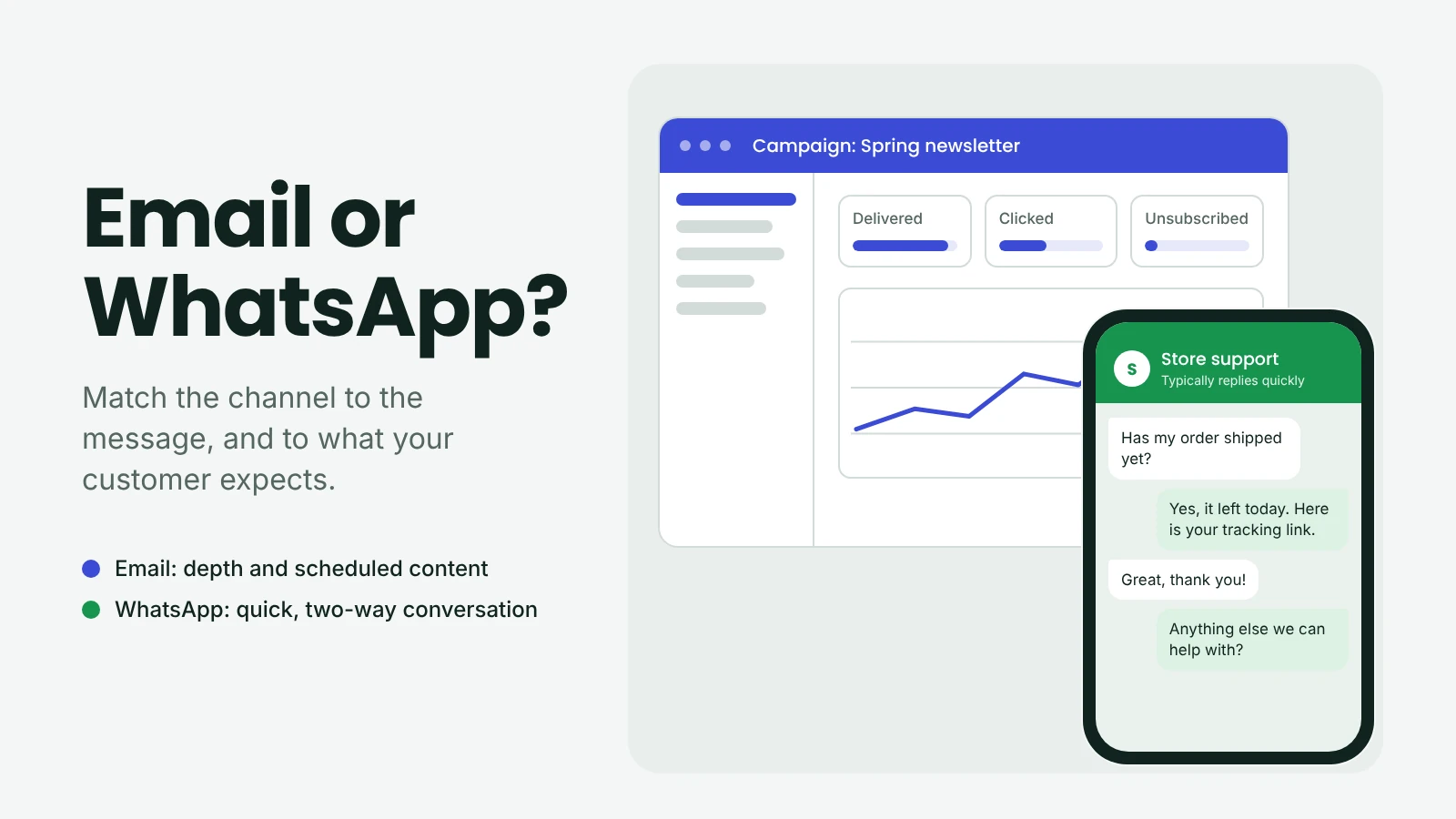
Email suits detailed, recurring content. WhatsApp suits direct, conversational exchanges. Many businesses use both, with each channel given a clear job.
Short answer: Pick the channel that fits the message and the customer's expectation. Use email for depth and scheduled content, WhatsApp for quick two-way conversations, and both when their roles are clear and the customer has agreed to each.
This guide compares use cases, automation, cost and measurement, then gives you a simple framework for choosing. For example, a retailer might send a monthly product newsletter by email and answer an order question on WhatsApp.
WhatsApp Marketing vs. Email Marketing: What Is the Difference?
What is email marketing?
Email marketing is permission-based communication with subscribers: newsletters, product updates, educational sequences and lifecycle campaigns. Capabilities depend on your email service provider.
What is WhatsApp marketing?
WhatsApp marketing means using WhatsApp for permitted campaigns, service updates and customer conversations, often with automation. Very small teams can start with the free WhatsApp Business app.
Teams that need multiple agents, integrations and automation usually move to the WhatsApp Business Platform (the API) through WhatsApp marketing software such as ChatDesq. Always check Meta's current opt-in and template rules.
WhatsApp vs. Email Marketing: Side-by-Side Comparison
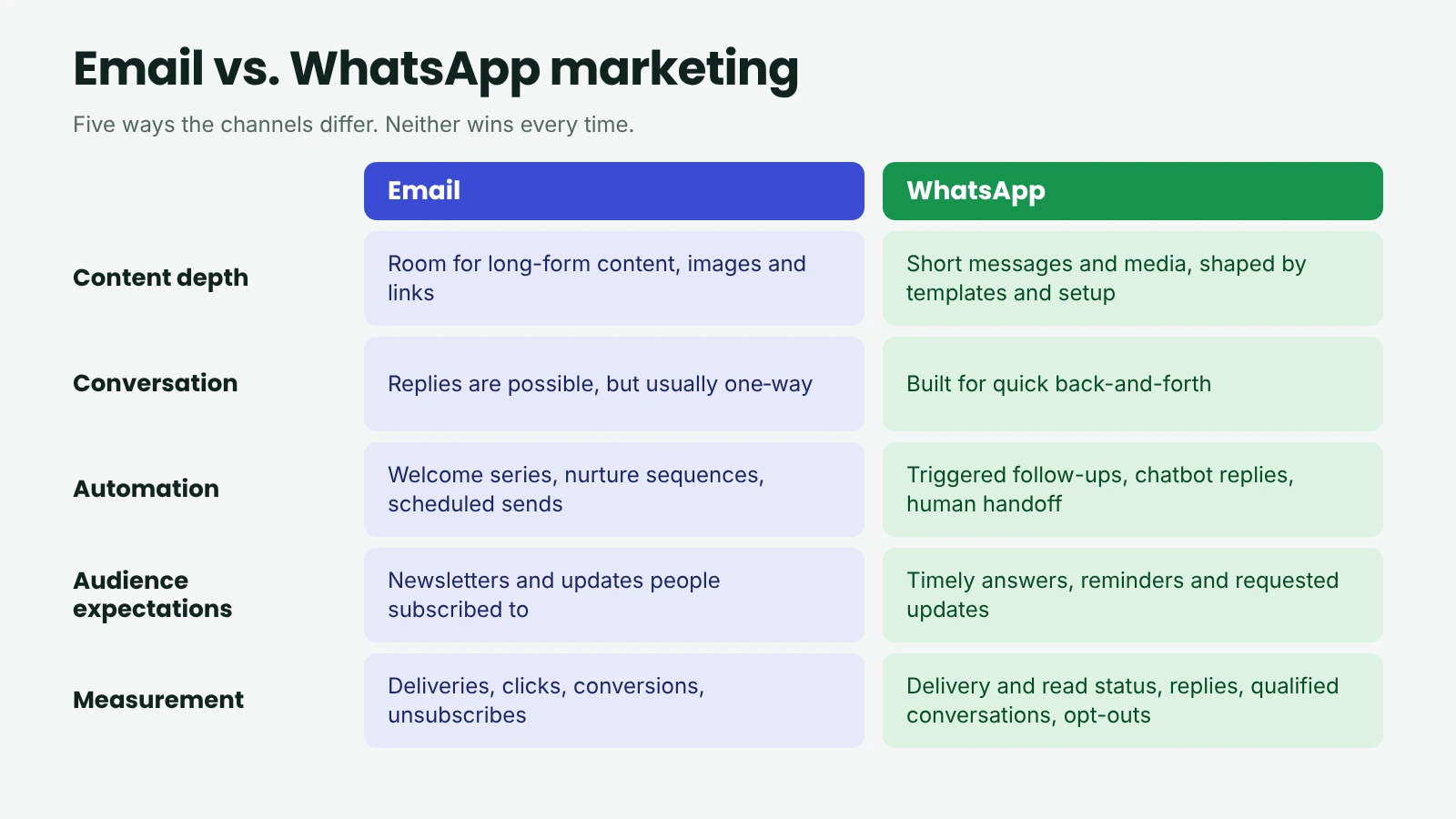
| Factor | Email marketing | WhatsApp marketing |
|---|---|---|
| Best for | Detailed, structured, recurring content | Direct, timely, conversational interactions |
| Format | Room for long-form content, images and links | Short messages and media, shaped by templates and setup |
| Conversation | Replies possible, but usually one-way | Built for quick back-and-forth |
| Automation | Welcome series, nurture sequences, scheduled sends | Triggered follow-ups, chatbot replies, drip sequences, human handoff |
| Personalisation | Segments and merge fields (varies by provider) | Contact details, conversation history and segments |
| Measurement | Deliveries, clicks, conversions, unsubscribes | Delivery/read status, replies, qualified conversations, opt-outs |
| Cost | Depends on list size, plan and volume | Depends on platform, message category, volume and team time |
| Permission | Email opt-in | Separate WhatsApp opt-in |
Exact features and prices vary by provider and plan, so compare real quotes instead of assuming one channel is cheaper. The better channel is the one that fits the message: a long educational newsletter and a same-day appointment confirmation are different jobs.
When Is Email Marketing the Better Choice?
Detailed content and newsletters. Long-form education, product roundups, guides and anything customers may want to revisit suit email, because it gives you room to structure the message.
Structured lifecycle campaigns. Welcome series, nurture sequences and scheduled newsletters work well for subscribers who have opted in. A B2B company, for example, might send a monthly product update and a case study by email.
When Is WhatsApp Marketing the Better Choice?
Direct, conversational interactions. Enquiries, customer-requested updates, quick follow-ups and service chats suit WhatsApp because customers can simply reply. A WhatsApp shared inbox keeps history and team ownership visible. A local service business, for example, can answer a new enquiry, share available slots and hand the chat to a teammate.
Targeted campaigns and timely updates. Relevant, opted-in campaigns can carry reminders, announcements and promotions through WhatsApp broadcast tool, within Meta's policies. Never use it for unsolicited contact: respect consent, frequency and opt-outs.
Which Channel Is Better for Different Business Types?
- Ecommerce and retail: email for collections and guides; WhatsApp for order questions and permitted time-sensitive campaigns. See ChatDesq for ecommerce.
- B2B and professional services: email for proposals and case studies; WhatsApp for quick lead conversations and meeting coordination.
- Education, salons and local services: email for course guides and newsletters; WhatsApp for enquiries, reminders and bookings. A course provider might email a detailed guide, then confirm a requested callback on WhatsApp.
These are illustrative patterns, not rules. Test with your own audience.
Can You Use WhatsApp and Email Marketing Together?
Yes, and for many businesses it is the practical answer. Three habits keep it working:
- Give each channel a clear role. Email carries depth and scheduled content; WhatsApp carries timely, conversational messages. Don't send the same campaign through both by default.
- Coordinate around the customer journey. Let customer stage, preference and activity decide which channel carries the next message.
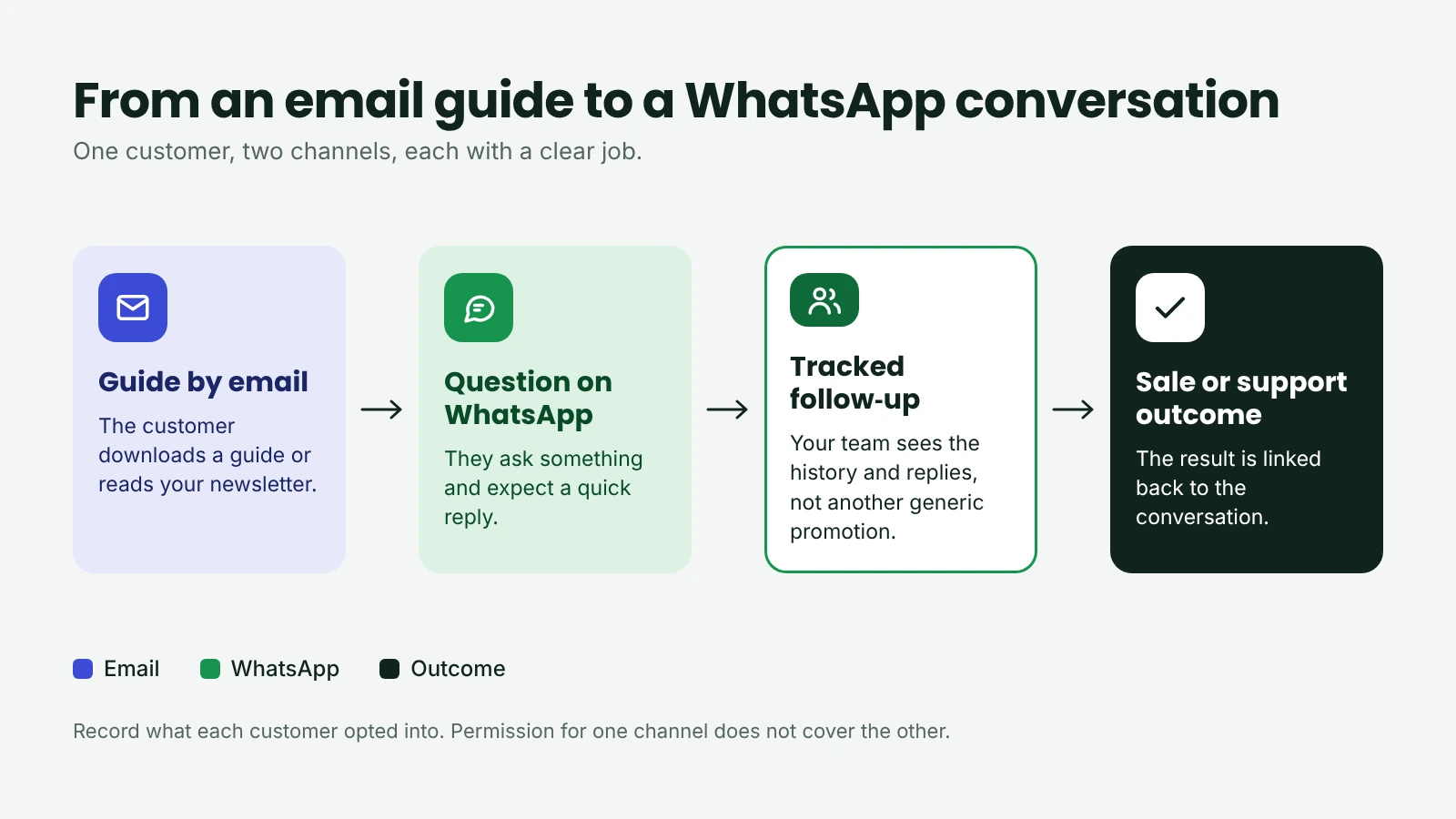
- Keep consent organised. Record what each customer opted into and what they have already received. Permission for one channel does not cover the other.
For example, a customer downloads a guide by email, then asks a question on WhatsApp. Your team sees the conversation and replies, instead of sending another generic promotion. Keep email in your email platform and manage the WhatsApp side with a WhatsApp automation tool for triggered follow-ups and a WhatsApp chatbot for business for common questions, with a route to a human.
How to Choose the Right Channel for Your Business
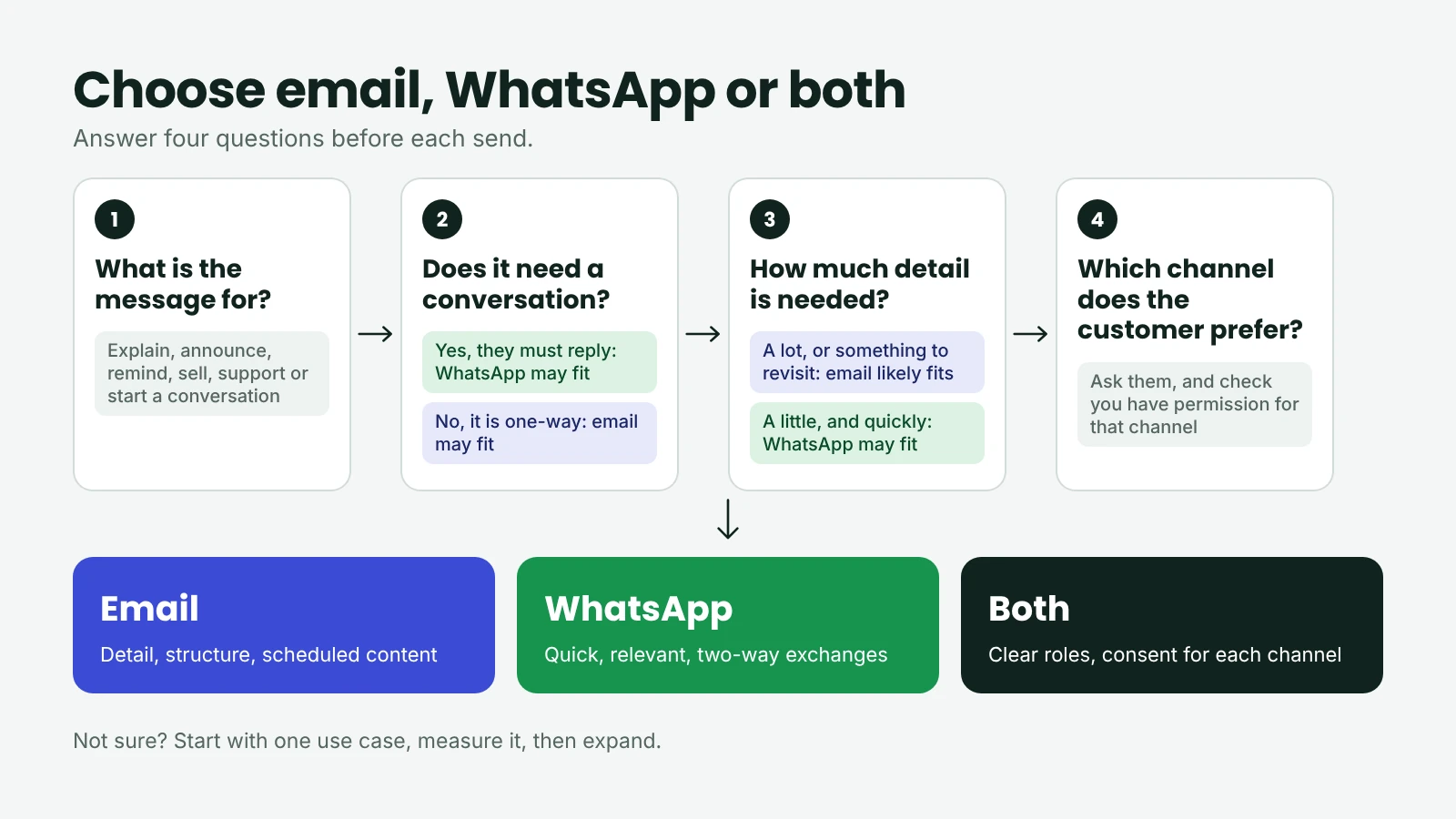
Ask five questions before each send:
- What should the message do: explain, announce, remind, sell, support or start a conversation?
- Where does the customer expect to hear from you? Ask them.
- Do you have permission for this channel, and is the contact data accurate?
- How much detail, urgency, segmentation and reply handling is needed?
- Can you measure the outcome?
Start with one use case, measure it, then expand. If the message needs a detailed explanation, email likely fits. If the customer must answer a quick question, WhatsApp may fit better.
Common Mistakes When Using WhatsApp and Email Together
- Sending the same message on both channels for no reason, such as a discount email and a WhatsApp message minutes apart.
- Contacting people without permission or ignoring opt-outs.
- Putting dense information in WhatsApp, or urgent conversations in email.
- Over-automating with no route to human support.
- Reporting opens or deliveries without linking them to leads and sales.
How to Measure WhatsApp and Email Marketing Performance
Compare like with like. For email, track delivery, clicks, conversions, unsubscribes and attributed revenue, treating opens with caution because privacy features can distort open tracking. For WhatsApp, track delivery and read status where available, replies, clicks, qualified conversations, conversions and opt-outs. Opens and replies are different behaviours, so never rank channels on a single metric.
Instead, compare outcomes such as qualified leads, bookings and purchases over the same attribution window (the fixed number of days after a message in which you count a sale), plus cost per qualified lead, including platform and team time. Watch opt-outs and complaints as guardrails.
Conclusion: Many Businesses Use Both Channels
Choose email for detailed, structured communication. Choose WhatsApp for relevant, direct interactions where customers expect a conversation. Combine them when their roles are clear and customers have consented to each.
WhatsApp marketing with no plan, no lock-in, and a person who answers. ₹0 platform fee. Pay only for the messages you send. See ChatDesq pricing or try the WhatsApp cost calculator.
Frequently Asked Questions
Is WhatsApp marketing better than email marketing?
Neither is universally better. Email often suits detailed, scheduled content, while WhatsApp suits direct, conversational interactions. The right choice depends on your message, customer preference, permissions and goal.
Can WhatsApp and email marketing be used together?
Yes. Give each channel a distinct role, coordinate timing around customer preference and suppress duplicates so customers don't receive the same offer twice.
Which is more cost-effective: WhatsApp or email marketing?
It depends on list size, message type and team time, so compare cost per qualified lead or sale. ChatDesq: ₹0 platform fee. Pay only for the messages you send. Marketing ₹1.036, utility / authentication / service ₹0.138 per message, excl. GST.
Is WhatsApp marketing good for B2B businesses?
It can be, where customers expect it: enquiries, follow-ups and meeting coordination. Email remains better for detailed documents and longer updates.
Do businesses need the WhatsApp Business API for WhatsApp marketing?
Not always. Team size, integrations and automation needs decide the setup. Very small teams may start with the WhatsApp Business app; verify Meta's current access and policy requirements.
Written by
Social media Marketer, Chatdesq
Surya Ranjha is a digital marketer and content writer passionate about technology, AI, and the evolving world of digital communication. He specializes in creating insightful, research-driven content on SEO, WhatsApp marketing, SaaS, and emerging digital trends. With a focus on making complex ideas accessible and actionable, he aims to help businesses and readers navigate the digital landscape with clarity and confidence.